



The Blueprint Is Simple: What Stew Baylor's Trainer Taught Us About Training the Right Way
By Garrett | Hydro Power
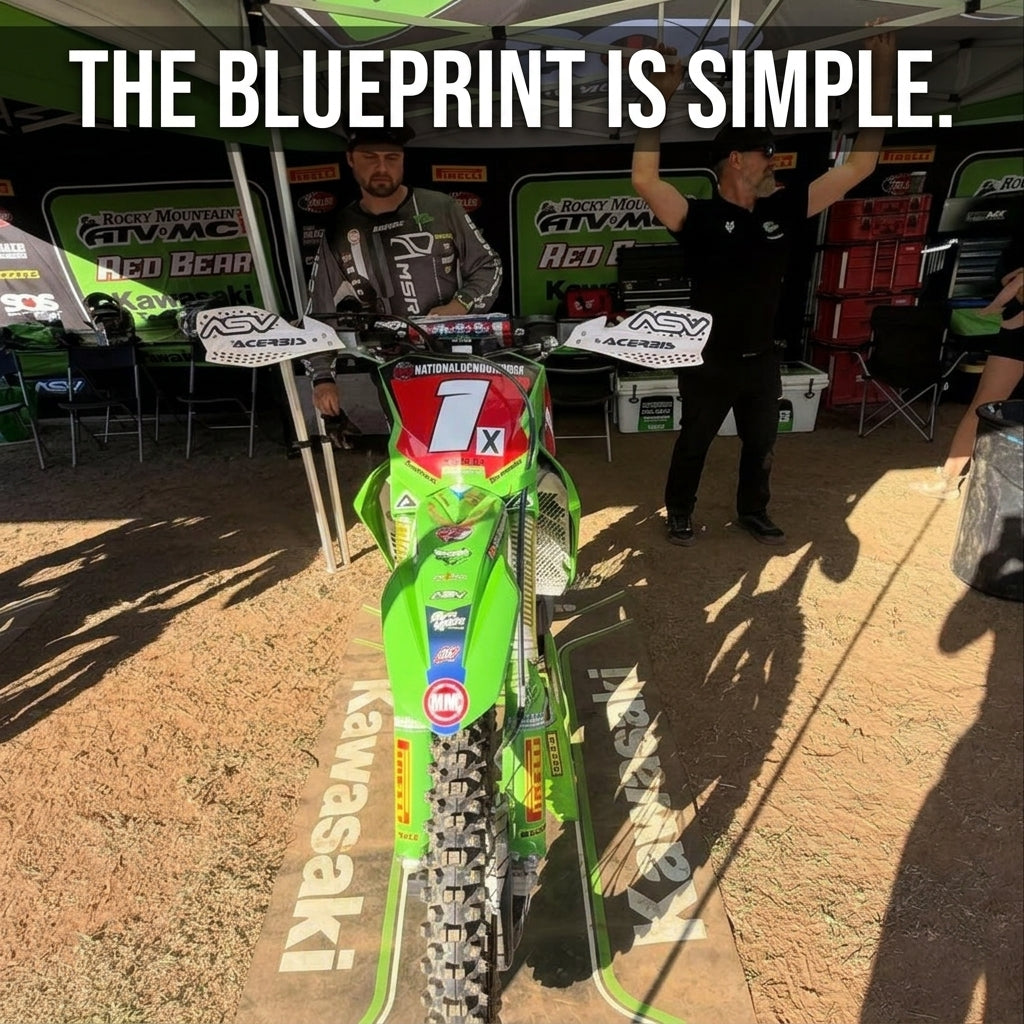
We recently got on a call with Stew Baylor's trainer.
Not to pick apart some secret protocol. Not to uncover some elite-only hack that the pros are hiding from amateur riders.
What we wanted to know was simple: What actually moves the needle for moto athletes?
And what he said wasn't complicated. In fact, it was the opposite.
It was exactly what we've been building the Moto Blueprint around — and most riders are still not doing it.
So let's break it all down. No fluff. No filler. Just the framework.
The Biggest Mistake Moto Riders Make
Before we get into the solution, we have to talk about the problem.
Most riders are inconsistent with the basics.
That's it. That's the problem.
Not that they're doing the wrong exercises. Not that they're on the wrong program. Not that they need a $400/month trainer.
They're chasing shortcuts. They see what pros post online and try to copy it. They jump from program to program every few weeks. They think results come from finding the right thing instead of sticking with any thing long enough to let it work.
Stew Baylor's trainer put it bluntly: "Absolutely the biggest mistake is a lack of consistency in whatever it is they're trying to do for training. Everyone is looking for the new reinvention of the wheel as some sort of accelerated shortcut to elite performance."
Here's the truth: Elite athleticism is built in seasons. Slowly. On purpose.
It takes years to build robust athleticism. Trying to rush it doesn't just fail — it often leads to injury, burnout, and regression.
So before anything else, commit to consistency. Then build on top of that foundation with a real framework.
The Framework: 3 Buckets
Moto training isn't complicated when you strip it down. Everything fits into one of three buckets.
Bucket 1: Strength
Let's clear something up first: we're not talking about getting jacked.
Strength training for moto athletes is about durability and injury resistance.
Motocross is brutal on the body. You're absorbing impacts for hours. You're holding on through rough terrain. You're fighting the bike when it doesn't want to cooperate. Over a long season, that takes a toll.
Riders who skip strength work tend to break down. Riders who build it tend to stay on the bike.
That's the whole point.
What to focus on:
- Compound movements — Squats, deadlifts, hip hinges. These build functional strength that transfers directly to the bike.
- Posterior chain — Your hamstrings, glutes, and lower back take the most abuse in moto. Train them directly and often.
- Upper body pulling — Rows and pull-ups for grip strength, shoulder stability, and arm pump resistance.
- Core stability — Not crunches. Planks, carries, anti-rotation work. The kind of core strength that keeps you connected to the bike when the terrain gets rough.
How much, by season:
- Off-season: 2–3 strength days per week. This is your window to build.
- Pre-season: Drop volume, increase intensity and speed. Shift from building to converting.
- In-season: Maintenance only — 1–2 sessions, nothing that leaves you too sore to ride or race.
The mistake most riders make is training heavy in-season and showing up to the gate already beat up. Strength is built in the off-season. In-season, you just keep it.
Bucket 2: Cardio — But Not Just Zone 2
Here's where a lot of riders go wrong.
Zone 2 cardio — the steady, easy-pace stuff where you could hold a conversation — is important. It builds your aerobic base. It makes your engine bigger. It improves your body's ability to recover between efforts.
But moto isn't a zone 2 sport.
Moto is explosive and unpredictable. It's high-intensity in short, violent bursts — followed by brief recovery — repeated for 30–40 minutes straight. If all you do is steady cardio, you build a diesel engine.
Moto needs a race engine.
Stew Baylor's trainer called it out directly: riders who only do steady-state cardio become "as explosive as a water bottle." Strong words. But accurate.
The fix: Train both.
Zone 2 — 1 session per week (off-season)
- 30–60 minutes at a conversational pace
- Cycling, running, rowing, swimming — whatever you'll actually show up for
- Builds aerobic base, improves fat utilization, supports recovery
Intervals — 1 session per week (off-season)
- Short, max-effort bursts with structured rest
- Examples: Assault bike sprints, hill repeats, sled pushes, Tabata-style circuits
- Builds your ability to work hard, recover fast, and do it again
- This is what translates directly to racing
As the season approaches, your conditioning should start to look more like racing. Shorter rest. Higher intensity. More moto-simulation style work.
This is the shift Stew Baylor's trainer talked about: from building to converting to performance.
Bucket 3: On-the-Bike Training
Here's the bucket most people undervalue — and it might be the most important one.
Nothing replaces saddle time.
You can be in incredible gym shape and still be slow on the bike. The coordination, the reflexes, the feel, the micro-adjustments — that only comes from riding. A lot. Over time.
Most riders either ride too much when they shouldn't be (mid-season when fatigue is already high), or don't ride enough when they should be (off-season when it matters most for skill development).
The smarter approach, by season:
Off-season: Don't over-structure it. Just get time on the bike. Work on technical skills — corners, jumps, lines. This is when you can experiment without race pressure.
Pre-season: Start adding structure. Simulate motos. Work on pacing. Build race-like endurance on the bike. Your fitness from the gym should be transferring — now test it under actual riding conditions.
In-season: Your race is your on-bike training. The goal between events is to stay sharp, not to pile on volume. Extra riding should be short and low stress. Manage fatigue so you show up to the gate fresh.
The goal every week is to be fresh and sharp when it counts — not to rack up hours for their own sake.
The Training Calendar: Season by Season
Putting it all together, here's how the three buckets shift across the year.
Off-Season: Build Everything
This is the foundation phase. You're not racing. You have the most room to push and recover.
Weekly structure:
- 1 zone 2 session
- 1 interval session
- 2–3 strength sessions
- Riding when possible — skills focus, not intensity
This is when you fix your weaknesses. Weak grip? Train it now. Bad aerobic base? Build it now. Movement patterns need work? Address it in the off-season — not mid-race-year.
Everything you build here is what you'll spend the rest of the year converting into performance.
Pre-Season: Shift Toward Specificity
Now it's time to convert what you built.
- Conditioning sessions get shorter, harder, and more race-like
- Strength sessions drop in volume, increase in speed and power
- On-bike sessions get more structured — simulate race distances and real conditions
This is the bridge between building and performing. You're not trying to get stronger here. You're trying to sharpen everything.
In-Season: Maintain and Protect
This is where most riders blow it.
They feel like slowing down means falling behind. So they keep training hard, carry fatigue into race weekends, and underperform — then blame their fitness.
The reality: you can't build fitness in-season. That window closed. What you can do is maintain what you already built and show up to the gate ready.
In-season priorities:
- 1–2 light strength sessions (nothing that wrecks you)
- Minimal conditioning — quality, not quantity
- Recovery is the real training: sleep, nutrition, hydration, stress management
- Manage travel fatigue — often underestimated across multi-race weekends
Stew Baylor's trainer put it perfectly: "Programming needs to be fluid week to week — and day to day."
Moto is unpredictable. Your body is unpredictable. Great programming responds to reality, not a rigid spreadsheet. If you took a hard crash in practice and your shoulder is tweaked, adjusting your week isn't weakness. It's smart.
The Fourth Element: Hydration and Fueling
Three buckets. But there's a fourth element that ties them all together.
And it's the one most riders sleep on.
Hydration and fueling.
Here's what happens when you get this wrong:
- Your zone 2 session feels harder than it should
- You bonk halfway through your interval workout
- You get on the bike already running on empty
- Lap times drop in the second half of the moto
- Recovery between training days is slower than it should be
None of that is a fitness problem. It's a fueling problem.
And here's what makes it so frustrating: it's the most controllable variable in your whole training life.
You can't control track conditions. You can't control the weather. You can't control who else lines up at the gate.
But you can control what you put in your body before, during, and after every session.
How fueling shifts by season:
Off-season (high training volume): Higher carbohydrate intake to fuel longer sessions. More overall calories. Hydration becomes more important as sweat rates increase with more frequent training.
Pre-season (transition phase): Balance performance and recovery. Time carbs around training sessions. Prioritize protein to support muscle quality as gym volume decreases.
In-season (race phase): Hydration is everything. Race day nerves, travel stress, heat exposure, and adrenaline all spike sweat loss and electrolyte demand. Research consistently shows that a 1–2% drop in hydration can cost measurable performance — and in a race decided by seconds, that matters.
How We Fuel It at Hydro Power
We built our products around exactly this philosophy — not as afterthoughts, but as core parts of the training framework.
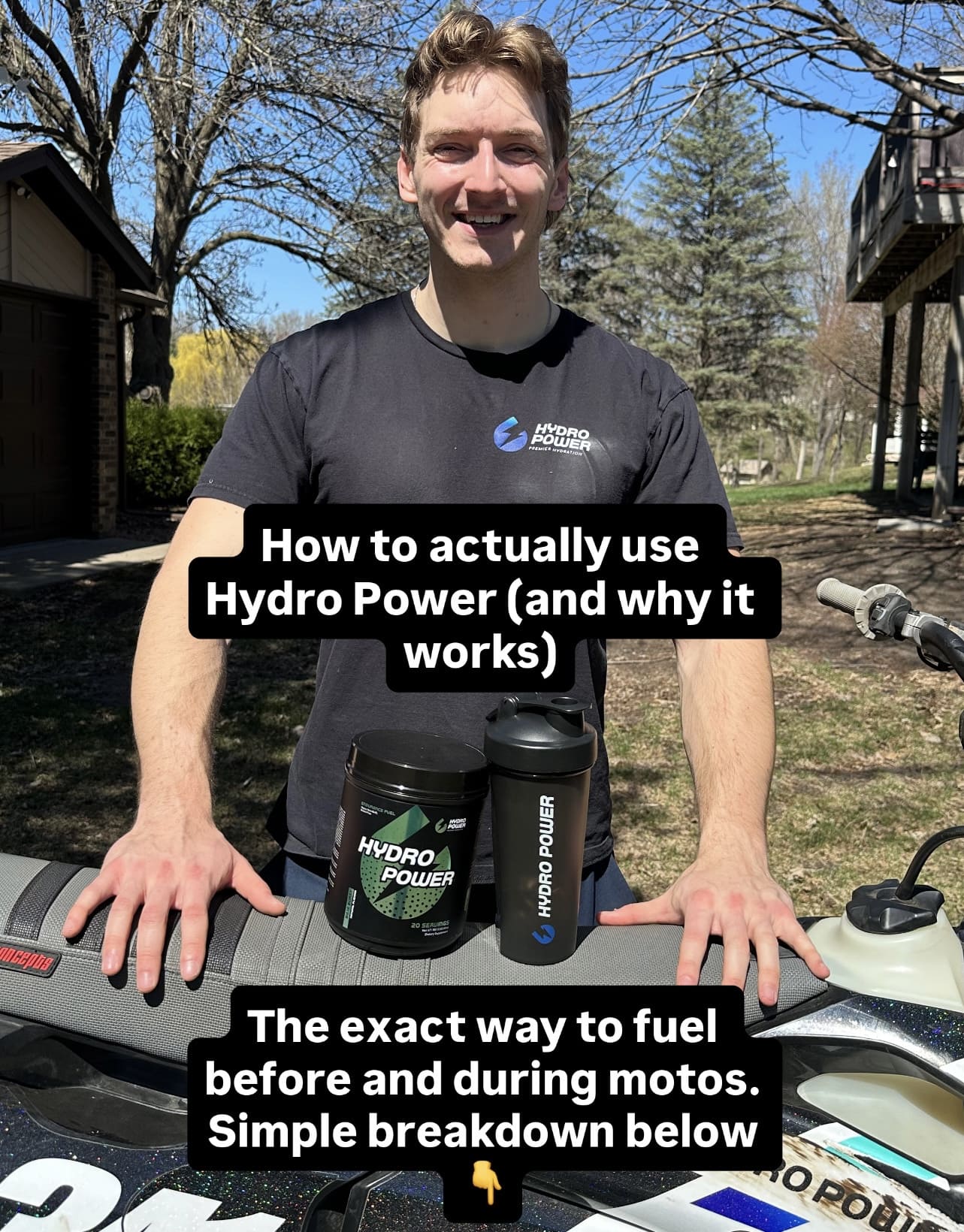
Endurance Fuel delivers 1,000mg of electrolytes and 40g of carbohydrates per serving. It's built for the sustained output that moto demands — not a 45-minute gym session, but long motos, hot race days, and back-to-back training blocks.
Ignite handles the mental edge — clean energy and focus without the crash. When you're 25 minutes into a tough moto and your mind starts to drift, that's what it's built for.
Because moto is as much a mental sport as a physical one. You need both.
👉 Shop Bundles & Stacks — Built for Moto Athletes
The Moto Blueprint App
Everything we've talked about in this post — the training structure, the seasonal shifts, the nutrition framework — is what we built the Moto Blueprint app around.
It's built for moto. And it's free.
What's inside:
- 10+ personalized training and nutrition plans based on your goals and where you are in the season
- Detailed workout instructions with video demonstrations — no guessing, no winging it
- 130+ custom meals with cooking instructions and a weekly shopping list built in
- A framework that adjusts as your season does — not a one-size-fits-all program
If you've been bouncing between random workouts and wondering why your fitness isn't translating to the track, this is the answer.
📱 Download on the App Store — iPhone
🤖 Get it on Google Play — Android
The Real Takeaway
None of this is groundbreaking. That's the point.
Three buckets. Done consistently. Adjusted by season.
Strength to stay durable. Cardio — both kinds — to build and convert your engine. On-bike time because nothing replaces it.
Tie it together with proper hydration and fueling, and you've got the framework that elite moto athletes actually use — not because it's complicated, but because it works.
Stop chasing whatever the pros post online. Stop jumping programs every three weeks. Stop looking for the shortcut.
The blueprint was simple the whole time.
— Garrett, Founder of Hydro Power
Quick Links:


Leave a comment
All comments are moderated before being published.
This site is protected by hCaptcha and the hCaptcha Privacy Policy and Terms of Service apply.